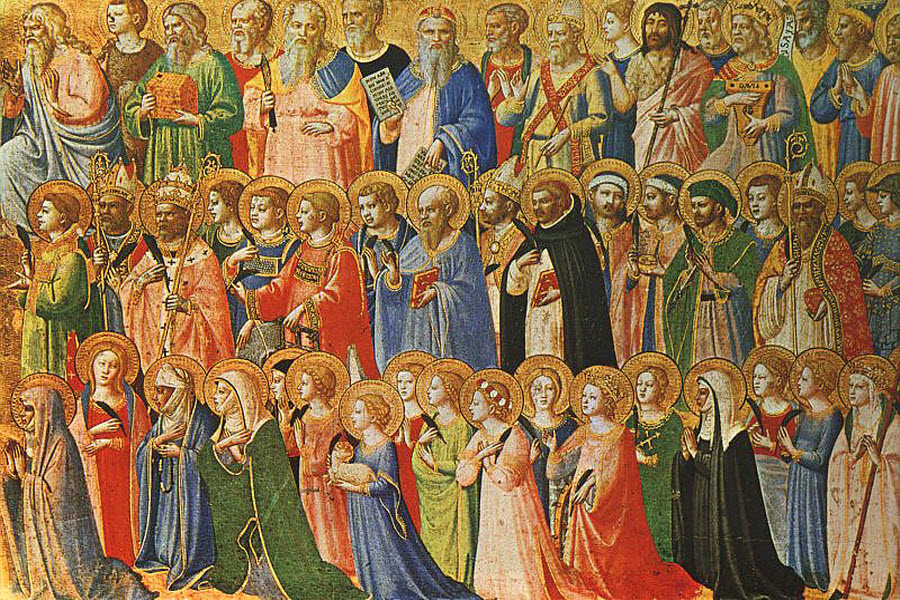
All Saints Day
by Fr. Bob Deehan | 11/01/2026 | Pastor's CornerToday, on the Solemnity of All Saints, we begin National Vocation Awareness Week—a special time to focus on vocations and to help young people listen for God’s call. This year our Church also celebrates the Year of St. Francis, whose life reminds us that holiness begins by listening to Christ and responding generously. Francis wrote, “Incline the ear of your heart and obey the voice of the Son of God.” That invitation is meant for every Christian.
God calls each of us to holiness, but He leads us there along different paths: marriage, priesthood, religious life, the diaconate, or generous single life. Our vocation is more than what we do; it is the particular way God calls us to love, serve, and ultimately become saints. During Vocation Awareness Week, ask the Lord to help you live your own vocation more faithfully—and encourage the young people in your life to ask a simple question with an open heart: “Lord, how are you calling me to become a saint?” (vianneyvocations.com)
As we anticipate the mid-term elections this Tuesday, the Church teaches (Catechism of the Catholic Church #2240) that voting is a primary responsibility for all Catholic citizens where we are called upon to contribute to our nation and promote the common good by applying the values and teachings of our Catholic faith to the issues facing our society. Primary among them is concern for the needs of the weakest and most defenseless among us, including the unborn. In the United States Conference of Catholic Bishops document: Forming Consciences for Faithful Citizenship, # 34 - 36, we’re reminded that “There may be times when a Catholic who rejects a candidate’s unacceptable position even on policies promoting an intrinsically evil act may reasonably decide to vote for that candidate for other morally grave reasons. Voting in this way would be permissible only for truly grave moral reasons, not to advance narrow interests or partisan preferences or to ignore a fundamental moral evil. When all candidates hold a position that promotes an intrinsically evil act, the conscientious voter faces a dilemma. The voter may decide to take the extraordinary step of not voting for any candidate or, after careful deliberation, may decide to vote for the candidate deemed less likely to advance such a morally flawed position and more likely to pursue other authentic human goods. In making these decisions, it is essential for Catholics to be guided by a well-formed conscience that recognizes that all issues do not carry the same moral weight and that the moral obligation to oppose policies promoting intrinsically evil acts has a special claim on our consciences and our actions. These decisions should take into account a candidate’s commitments, character, integrity, and ability to influence a given issue. In the end, this is a decision to be made by each Catholic guided by a conscience formed by Catholic moral teaching.” Cf. forming-consciences-for-faithful-citizenship.pdf
God bless you!